This post originally appeared on Quill and the Classroom.

It’s October, which means one of my favorite holidays is fast approaching: Halloween. While it’s been a lifelong love of mine, the past several years have been especially fun as my daughter and I have started a tradition of dressing up together. And we take it pretty seriously: costume design begins in the summer and production typically starts in September. This year’s undertaking involves an ambitious amount of homemade bedazzling. We’ve got big shoes to fill after last year’s tribute to two of our favorite characters from the wonderful world(s) of Oz: Glinda and Elphaba.

I’ve had those characters in my mind in the runup to this Halloween, bedazzler in hand, thinking about the classic arc of a hero’s journey and the specific bumps in the Yellow Brick Road that Dorothy encounters… and how they remind me of my work with schools and districts on literacy implementation.
In every iteration of L. Frank Baum’s story, Dorothy and her companions have a destination (the Emerald City), a path (the Yellow Brick Road), and a pretty good idea of what they hope to find at the end (the wish-granting Wizard). But getting there requires considerably more than knowing which road to take. Along the way, they encounter all sorts of obstacles and distractions—apple-hurling trees, a fireball-handling witch, and just outside the Emerald City, a field of poisonous poppies that cause Dorothy, Toto, and the Lion to fall into perpetual sleep. . . until a magical snowstorm breaks the spell (thanks Glinda!) and the journey continues..
This is what worries me about this moment in literacy reform. We’ve spent years helping school systems figure out which road to take. Districts large and small have made their way past curriculum selection and adoption obstacles. Now, just when the real work of the journey is underway, just as we can catch a glimpse of our destination, we’re entering the field of poppies. And we can’t afford to fall asleep.
Adoption Is Not Implementation
As a field, we’ve made tremendous progress in helping school systems develop a stronger, evidence-based vision for literacy instruction. Increasingly, systems are adopting high-quality instructional materials aligned with that vision and investing in professional learning to help teachers get started. This is important progress, and worth celebrating.
But what happens next?
Literacy and instructional coaches like me often lean on the science of reading to help us understand what effective literacy instruction should look like. What research can help us understand how to implement it effectively, especially at scale? Fortunately, there’s a substantial body of research on organizational change and continuous improvement to guide us.
One of my favorite tools when coaching schools and systems is the Lippitt-Knoster Model for Managing Complex Change. This conceptual framework identifies five essential ingredients for successful change: vision, skills, incentives, resources, and an action plan. If any one of those elements is missing, change cannot succeed (instead, you end up with frustration, resistance, and a grab-bag of other bad results):
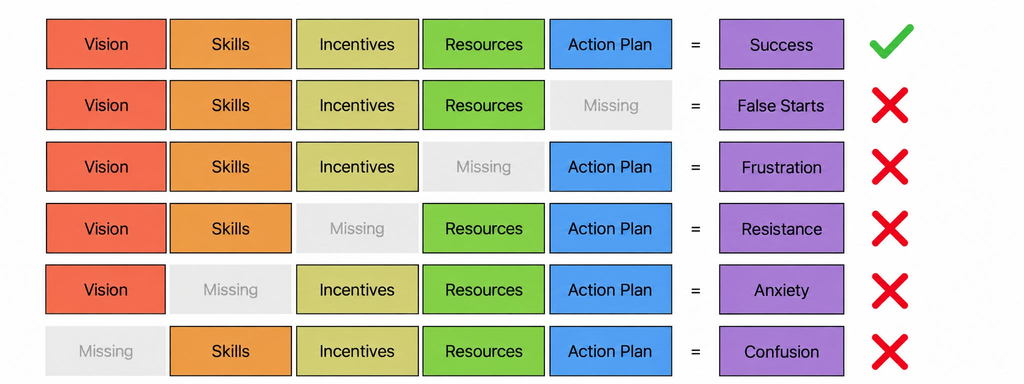
This framework and visual tool are particularly useful for diagnosing what’s missing when well-intentioned improvement efforts aren’t producing the desired results. Consider a school district that has articulated a strong vision for literacy instruction, adopted a curriculum aligned with that vision, and provided teachers with some initial training. Leaders may reasonably feel they’ve checked the important boxes and can now expect the new curriculum to show up in classroom practice.
But is it? And have they?
Maybe the vision is clear to the leadership team but fuzzy when translated into everyday instructional decisions. After all, clear to one person—or even one leadership team—isn’t necessarily clear to everyone, particularly practitioners who lead classrooms in day-to-day efforts. Or maybe teachers attended trainings, but haven’t yet developed the expertise to teach the lessons well. Perhaps they lack time to internalize lessons and practice together, or competing priorities make it difficult to give the new curriculum the attention it deserves.
And here’s the kicker: Maybe nobody is looking closely enough to know which of those things is actually happening. The problem isn’t necessarily that districts have chosen the wrong reforms. It’s that they often don’t know enough about how those reforms are unfolding.
If You Want to Know How It’s Going, Look at What’s Happening
Much of my work involves partnering with system leaders to help ensure that their plans for stronger literacy instruction actually materialize in classrooms. Some of the first questions I ask are fairly straightforward: Are teachers using the materials the system adopted? And how well are they using them?
If I had a nickel for every time I asked how implementation was going and someone responded by pulling up student achievement data, I’d have a lot of nickels.
Don’t get me wrong. Student achievement matters enormously—improving outcomes for kids is ultimately why we’re doing this work. But assessment results are largely lagging indicators. They tell us something about the outcomes of instruction, not necessarily whether the instructional changes we intended to make actually occurred.
There’s an important measurement step between adoption and achievement. And that step is measuring implementation itself.
The Carnegie Foundation’s work on practical measurement for improvement offers a useful foundation. Rather than relying exclusively on eventual outcomes, improvement science emphasizes collecting timely, actionable information about the practices and processes we’re trying to strengthen. The goal isn’t simply to determine whether something worked, but to learn what’s happening so we can make it work better.
So what does that look like in the field?
I encourage school systems to develop a manageable plan for regularly visiting classrooms and collecting evidence of implementation. This doesn’t require observing every single teacher in every single school. A thoughtfully selected sample across schools, grades, and classrooms can reveal meaningful patterns, especially when leaders use a small set of consistent, research-informed indicators.
I suggest starting with two questions.
Question 1: Are teachers using the materials?
Before worrying about perfect implementation, let’s establish whether implementation is actually happening. Two or three indicators like these can help determine the answer to this question:
- Are teachers using the adopted curriculum, including its core texts and instructional routines?
- Are students engaging with those materials and routines?
- Are teachers routinely substituting, skipping, or significantly modifying components? If so, which ones?
This isn’t about policing teachers or demanding mindless compliance. It’s about understanding whether the system’s intended instructional approach is actually reaching students—and identifying what’s getting in the way when it isn’t.
Question 2: How well are teachers using the materials?
Once we’ve established that the curriculum is being used with reasonable consistency, we can dig more deeply into instructional quality. Again, a few lean indicators can serve as a guide.
For example:
- Are teachers asking questions that help students make meaning of complex texts?
- Are students developing knowledge and vocabulary through discussion and writing?
- Are teachers providing scaffolds that help students access challenging content without doing the thinking for them?
Of course, usage and quality aren’t entirely separate stages; leaders should pay attention to both from the outset. But the distinction matters. If teachers aren’t using the curriculum at all, that’s a very different improvement challenge than if teachers are using it consistently but struggling with a particular instructional practice.
And those different challenges require different responses.
And, therein lies the payoff: When we actually look at implementation, we can stop guessing about what teachers need and start making informed decisions about how to support them.
The What Is Clear. The How Is Messy.
I’ve had the pleasure of working closely in some of my implementation coaching with the brilliant Rachel Curtis, coauthor with Elizabeth City of Leading Strategically: Achieving Ambitious Goals in Education. In our work, one of the ideas I continually return to is the distinction between the what and the how. School systems can be clear about what they want to accomplish and still have an enormous amount to learn about how to accomplish it.
And that’s okay! In fact, that’s the work.
Imagine classroom observations reveal that teachers are consistently using the district’s new ELA curriculum. Terrific! But the observations also reveal that many teachers are rushing through the portions of lessons designed to help students actually grapple with the knowledge and vocabulary they can build from the included complex texts.
Now we’ve learned something useful.
Rather than launching another broad professional development initiative, leaders can focus on that specific instructional challenge. They can help teachers understand why those moments matter and give them time to unpack the text and prepare to teach their lessons. They can provide targeted coaching and feedback, and then return to classrooms and look for evidence of improvement. And then the cycle begins again, focusing leaders and teachers on consequential, bite-sized priorities that, one step at a time, keep them moving in the right direction.
Observe. Learn. Prioritize. Support. Repeat.
As I’ve argued before, the goal isn’t to improve everything at once. And it’s not to get implementation perfect on the first try.
The goal is to get a little smarter about it every time we look. And the looking is as important as the doing. That’s also why an implementation action plan, per the Knoster-Lippit model, shouldn’t simply be a list of activities to complete. It should establish a process for learning what is and isn’t working, adjusting supports, and checking again.
Ease On Down the Road
We’ve made real progress in helping schools get on the right road. We know more about what strong literacy instruction looks like, and we have better tools to help teachers deliver it.
But following the Yellow Brick Road isn’t the same thing as reaching the Emerald City.
The journey requires more than a map. It takes brains to figure out what’s working, heart to invest in the people doing the work, and courage to confront what isn’t going well. And when the poppies beckon—when implementation starts to feel tedious, the results aren’t coming fast enough, and the next shiny initiative begins to look awfully appealing—we have to resist the temptation to stop. We have to keep looking, learning from it, and improving our craft.
Or, as they say in The Wiz, ease on down the road.