This post originally appeared on Quill and the Classroom.
Recently, I attended ResearchED NYC, a fantastic conference that brings together education researchers and practitioners from around the world. It’s a great way to find out which ideas and practices are gaining traction—and which ones are under-utilitized, unpopular, or not-yet understood.
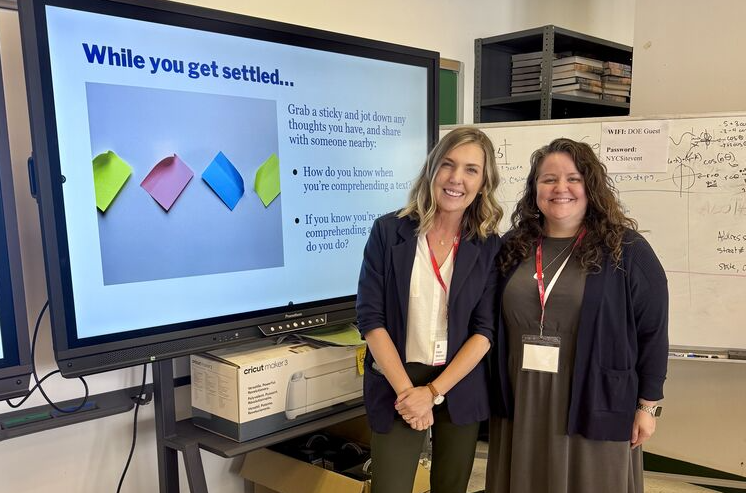
My pal Chelsea Harned and I presented a session called “The Hidden Architecture of Reading Comprehension.” Our goal was to inform and inspire our audience of educators, by exploring what cognitive science tells us is happening in the brain when students build and assemble the components of strong reading comprehension.
When we described the role of automatic word reading, everyone in the room nodded vigorously. Educators increasingly understand the role of fluent decoding in reading success, and that’s a real win. But the nods all but disappeared when we talked about text-based instruction that helps students draw knowledge and vocabulary from long-term memory, monitor for meaning while reading complex text, and slow down or re-reading passages that need more attention.
After the session, multiple thoughtful teachers came up to us and said things like:
“My school adopted UFLI…but we don’t really have anything for comprehension.”
“We have a phonics system, but then everyone just kind of grabs texts they like to teach standards.”
And one teacher said something that has stayed with me:
“We’re working on science of learning techniques like retrieval practice, but now I think the content of what we’re asking students to retrieve isn’t right.”
My heart sank, and I was left with this question: Are we building coherent systems for decoding but leaving comprehension to chance?
“Just Fold in the Cheese”
My colleagues and I ran into a similar question while discussing an excellent new Fordham Institute report making the rounds in literacy circles. The report surveyed teachers about their understanding and implementation of the science of reading. It includes this item: “Please select the 2–3 instructional materials in each row and column that you rely on to teach ELA.”
Here is the reported response:
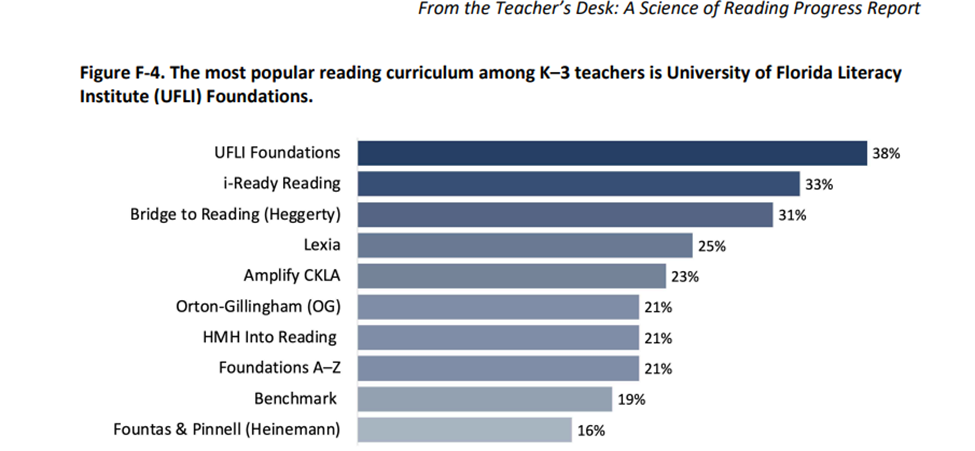
As we read through the list, we all had the same reaction: Wait…do all of these count as curriculum now?
These are very different instructional tools: foundational skills curricula, interventions, adaptive assessments, phonics supplements, instructional approaches, and core literacy curriculum. They are not all trying to do the same thing. That distinction matters because—as the teachers I met at ResearchEd are experiencing—schools can unintentionally believe they have adopted a complete literacy solution when in reality they have adopted only one component of reading instruction.
As a field, we’re getting clearer about what we value in literacy, but we’re still surprisingly nonstandardized about what we call things. And in complex work like implementing the science of reading, that matters more than we might realize.
Doug Lemov discussed this idea during a webinar earlier this year, describing how simply having precise language for an instructional move deepens a teacher’s ability to see it, practice it, coach it, and refine it. Once we share common vocabulary, we’re better positioned to improve.1
It’s not always easy, and when I collaborate with school-system leaders, we talk a lot about clear and comprehensive communication. I often use a clip from “Schitt’s Creek” where Moira Rose keeps instructing her son David to “fold in the cheese” while making an enchilada recipe that neither of them really knows how to cook. David, baffled and panicked, keeps asking the obvious question:
“How do you fold it in?”
Moira simply repeats, with growing confidence:
“You just…fold it in!”
After a few rounds of this, David gives up and storms out of the kitchen.
It is genuinely one of the funniest scenes on television—and it also perfectly captures a real implementation problem in education. How often have we, as literacy leaders, given instructions without making their meaning clear? How often have we all sounded a little like Moira?
“Build more knowledge!”
“Focus on robust comprehension!”
“Use the Science of Reading!”
All important ideas. But without clear, shared definitions, educators are left standing there like David Rose, wondering:
“Okay…but what exactly am I supposed to do?”
Guilty as charged. I’m a recovering addict from education and research jargon myself, but committed to naming the things we want to see in ways that are both clear and energizing.
A Field Guide for the Science of Reading
We need to name what we’re doing.2 In the spirit of building a shared vocabulary, here’s my unofficial field guide.
1. Curriculum (other aliases: Core Instructional Materials, Tier 1 materials, HQIM)
These are comprehensive literacy curricula designed to support the full complexity of reading comprehension over time. Strong core materials intentionally build knowledge, vocabulary, discussion, writing and sustained engagement with meaningful texts. Programs like CKLA—teachers’ No. 5 response to the Fordham survey question—fit into this category.
While we’re here, a quick side note: I sometimes jokingly refer to certain heavily marketed programs as “Fake-QIM.” These are the ones presented as though they can do everything for a teacher short of pouring their coffee in the morning, but when you look under the hood, the coherence starts to fall apart: disconnected texts, fragmented tasks, and lots of activity misaligned to the full body of reading research. Separating HQIM from Fake-QIM isn’t as easy as you’d think, which is why strong curriculum review tools are important.
2. Foundational Skills Programs
Programs like UFLI Foundations, the top response to the survey question, focus specifically on one critical side of reading: word recognition. These programs provide systematic, explicit instruction in phonemic awareness, phonics, decoding, encoding, and fluency. These programs are enormously important to reading comprehension because if students are laboring over decoding, cognitive load becomes too high for comprehension processes to function effectively.
But here’s the important distinction: these programs are not designed to comprehensively build readers. They don’t address knowledge-building, vocabulary, discussion, writing, or deep comprehension of worthwhile grade-level texts. They are pursuing building automatic word reading. That’s absolutely worthwhile, but it’s not the endpoint of literacy instruction, it’s the gateway.
Most foundational skills curricula, including UFLI, are intended to be paired with a broader comprehension and knowledge-building curriculum. For example, Wit & Wisdom intentionally partners with Wilson Reading’s Fundations program so schools can coherently build a complete literacy system.
3. Instructional Supplements and Intervention Platforms
This is where things get especially muddy. Programs like Heggerty, Lexia, and i-Ready are frequently discussed alongside core curriculum, but they serve a different purpose. Some target narrower components of reading development, like phonemic awareness or fluency. Others are designed primarily for intervention, adaptive support, additional practice, or progress monitoring.
Many can be helpful—some are excellent in the right context. But in any case, they are not designed to serve as the entirety of a school’s literacy curriculum. And it’s important to be careful here: the research base behind some of even the most popular programs is flimsy, and there’s growing evidence that intervention works best when it coheres with core instruction rather than pulling students into disconnected experiences all day long.
4. Instructional Approaches
One of the most surprising entries on the survey question list was “Orton-Gillingham.” That’s because Orton-Gillingham is not a curriculum—it’s an evidence-based structured literacy approach. Wilson Reading and IMSE are examples of foundational skills programs influenced by that approach. Orton-Gillingham provides a popular training platform to help teachers best understand the core principles in such materials.
***
These distinctions may sound technical, but they matter tremendously when schools are making decisions about what programs to invest in with limited funds.
While we can (and should!) celebrate the growing use of strong foundational skills programs, that is just one piece of the puzzle. Fluent decoding is not the end-goal. We want students to read and understand what they read—to make meaning, to engage in reflection, to be ready to talk and write about the text at hand. But comprehension does not magically emerge once students can read words automatically.
Students need coherent opportunities to build knowledge and vocabulary, discuss meaningful ideas, write about complex texts, and engage in sustained reading that deepens understanding over time. And that means teachers deserve curriculum, not piecemeal programs, intentionally designed to support that work. Let’s choose our words carefully, and in context.

Sign up to receive In The Know blogs and related updates.
- There’s substantial research suggesting that shared vocabulary and shared mental models improve performance in complex organizations. Studies on organizational learning and implementation science consistently show that clarity of language improves coordination, decision-making, and execution.
↩︎ - Or, as ResearchED NYC keynote speaker Nidhi Sachdeva said when discussing evidence-based teacher development: “We can’t develop what we can’t name.” ↩︎