This post originally appeared on Quill and the Classroom.
It’s August, which means it’s back-to-school season, and there is a certain buzz in the air. Local stores are stocked with fresh pencils and notebooks. Teachers are arranging their classrooms with excitement. Kids are begging their parents for the latest back-to-school kicks.
Ambitions are high. Parents like me are optimistic: This is going to be our year—the one where we finally stop turning in permission slips five minutes before they are due, after finding them crumpled at the bottom of a messy backpack. Homework will be done before a home-cooked dinner hits the table. No one will squabble, watch mindless TV, or oversleep. We’ll remember when picture day is and somehow manage to time the fresh haircuts just right.
Meanwhile, principals and school leaders are sitting in their offices, looking at their calendars for the next couple of months, and making their own big promises. This year, I’m going to do a 60-minute observation, with a full feedback conversation, every single day. I. Can. Do. It!
We’re all relishing a fresh start, and a new shot at greatness. Hope springs eternal.
I love this about working in schools. But when I think about the research I’ve studied on school improvement at scale, I can’t help but worry.. Frankly, we’re all chasing spectacular, when what we really need is good.
We dream of delivering awe-inspiring lessons every day, alongside perfectly executed program overhauls and Pinterest-worthy bulletin boards. The ambition is admirable, and these things might even be possible. But unless you’re already doing them, this is not a helpful mindset or standard at the start of a new school year. And it doesn’t line up with what we’ve learned about how excellent schools become so.
Here’s my recommended playbook and the evidence behind it: School leaders, this year I’m calling on you to chase consistency. Get rid of flashy leadership mantras and focus on supporting something teachers can do reliably and well. Go for discipline, not dazzle.
For my fellow basketball fans: think less Power Forward, more Point Guard. Less dunk-contest highlight reel, more John Stockton showing up without flash, but flush with fundamentals—and dishing out 12 assists. Again. And again. And again.
What Strong School Systems Pursue
It’s easy to understand why we think we should pursue greatness at the start of each year. Much like New Year’s resolutions, education pop culture encourages us to do it—as do the reels that pop up on our Instagram feeds. Modern wisdom tells us to chase “good to great.”
But evidence from the field suggests that the path to excellence isn’t really paved with spectacular displays and world-class experiences. It’s built on something surprisingly simple: consistency.
School systems that improve—and sustain that improvement over time—demonstrate that one of the core ingredients of success is as old as Aristotle: excellence is a habit. It’s not an overnight reinvention. Excellence builds by doing good one day, and then again the next. It’s not glamorous—this is the realm of the tortoise, and the Little Engine that Could. The trick is to keep at it. .
Take TNTP’s The Opportunity Makers. The report studies “trajectory-changing schools,” outliers whose students start out the year below grade level, make rapid progress (1.3 years’ worth every school year), and catch up by the time they leave the school. They didn’t just do that once—the schools in the study had maintained that accelerated growth for at least 10 years. Here’s my favorite finding from the report: the biggest difference isn’t how often trajectory-changing schools are great. It is how rarely they are bad.
Researchers observed 500 lessons in five diverse school systems and rated them as strong, good, or poor based on 20 different factors. They then compared lesson ratings in a typical school with that of trajectory-changing schools. In typical schools, 46 percent of lessons were rated poor compared to 8 percent in trajectory-changing schools. In other words, kids in typical schools are about six times as likely to experience a poor lesson. And weak instruction is almost a coin flip.
That’s not the case for kids in trajectory-changing schools. They aren’t playing “the teacher lottery” from year to year. They can expect good instruction in most classrooms, in most grades, most of the time.
TNTP calls this “stacking good days.” Week after week, year after year, good days add up. That’s a much less glamorous theory of school improvement than chasing perfection. But it may also be a much more powerful, and attainable, one. Indeed, researchers note in the report that trajectory-changing schools “invested in one focus area first and improved step by step, putting in sustained effort year after year.”
And by the way, more than a third of their lessons were rated strong. Good doesn’t have to sacrifice great:
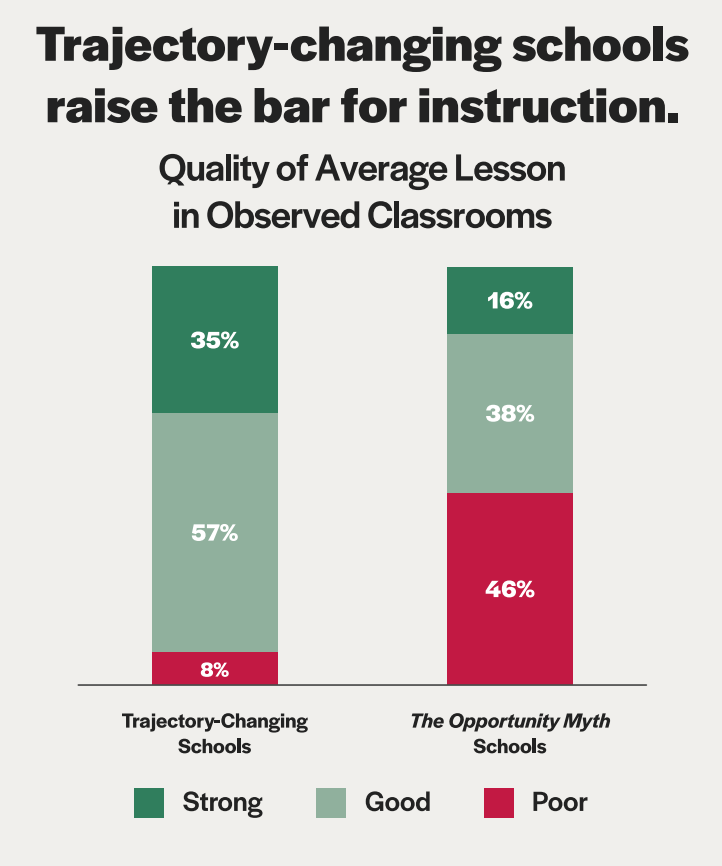
From TNTP. (2024). The Opportunity Makers: How a Diverse Group of Public Schools Helps Students Catch Up—and How Far More Can.
This report squares with a larger body of research on school improvement and implementation in the field. Michael Fullan argues that systems that improve and sustain their improvement are incredibly focused, engaging in what he calls “relentless consistency”—focusing on a small number of core instructional priorities and driving them forward, day after day, without getting sidetracked by every new fad that comes along.
And in How the Other Half Learns, a year-long account of the extraordinarily high-performing NYC charter schools Success Academies, Robert Pondiscio describes a system that has essentially “routinized” what it does well. The curriculum, expectations, routines, feedback, and even the smallest details of school culture happen again and again, until eventually they don’t really feel like “initiatives” anymore. They are simply how school is done. Habits matter.
I think that last point is important, because none of this is an argument for mediocrity or for lowering our expectations. Consistency isn’t the opposite of excellence. It’s how excellence gets built.
Plays for Principals
When I share this research with school leaders, there is often a simultaneous lightbulb and sigh of relief: this feels remarkably doable. Not easy, but attainable.
So, here’s what I propose to my friends who are school leaders, concretely:
Remember that plan—and the mantra about one full-length observation and feedback conversation every day? Ditch it.
Five hours of observations each week with a lengthy Danielson Framework in front of you (or some iteration of it), trying to capture every teacher move so you can provide comprehensive feedback later, probably isn’t the best path to big improvements. For starters, it’s hard for a teacher to absorb feedback on that many things in one sitting. They can probably only process two or three core ideas anyway.
So why not take Michael Fullan’s advice and, from the start, focus on just a couple of priorities?
That doesn’t mean full-length observations or comprehensive teaching frameworks don’t have a place. They do. But they don’t have to be the primary way you spend your instructional leadership time. Instead, imagine getting into more classrooms, more often, focused on the same few important things—and giving more teachers small, actionable pieces of feedback that help everyone get better at critical instructional practices.
Here’s how that could look, using an example focused on ELA instruction:
Let’s say one of our school and system priorities in literacy this year is getting kids talking about worthwhile texts as a way to build language, oracy, and knowledge. Instead of walking into classrooms trying to capture everything happening across a comprehensive teaching framework, we could narrow our lens to just three questions:
- Are students reading a worthwhile text?
- Are students getting to talk about that text?
- How well is that discussion going–is it surface level, or are they discussing deeper meaning?
Now imagine what that change in focus could do to the way you spend your time each week:
| Old Model | New Model | |
| Focus | Multiple indicators across a comprehensive teaching framework | One shared instructional priority |
| Total Observations | 5 per week (1 per day) | 15 per week (3 per day) |
| Observation Length | 60 minutes | 45 minutes (15 minutes x 3) |
| Feedback | 30-minute debrief | 10-minute debrief x 3 |
| Total weekly time | 7.5 hours | 6.25 hours |
| Reach | 5 teachers | 15 teachers |
In Atomic Habits, James Clear famously describes habits as the “compound interest of self-improvement.” Think about the compounded impact of a model like this. A principal gets back more than an hour each week (might I suggest actually eating lunch sitting down a couple of times this week?) while reaching three times as many teachers, all of whom are getting feedback on the same small set of things the school has decided really matter.
And, of course, this isn’t just an ELA idea. In a math classroom, you’d change the lens to the one or two things your school is trying to get better at in math. The point is not that every teacher needs the exact same feedback. It’s that you’ve decided, collectively, what you’re trying to get better at—and then you do a whole lot of reps helping people get better at it.
I resist the urge to go on and on, but you can use this same model for other aspects of your work too: observing PLCs, checking in with students, and even encouraging your teachers to apply the same principle of simplicity with consistency in their own work. For example, when I coach teachers who are planning teach an ELA lesson together, I suggest two things (just two!): A) ahead of your planning meeting, read the text you are going to read with students, and B) when you meet, discuss two questions:
- What are students going to gain from reading this text–as in, when they make meaning from it, what knowledge and vocabulary will they build?
- What’s going to be tricky about this text for students?
That’s it.
You could undoubtedly come up with a much more sophisticated team-teaching lesson-preparation protocol. You could make a beautiful template, add more questions, build in additional steps. And some of those things might even make it better. But they also might make it less likely that teachers keep engaging in preparing to teach together, much less having meaningful conversations. The trade-off for the shiny additions is often that the practice happens far less often.
Importantly, answering these two simple questions, lesson after lesson, builds expertise in teachers. Over time, they get better at anticipating where students might struggle, understanding what matters most in a text, and making better moment-to-moment decisions when teaching their curriculum. Much like observing teachers in short bursts with focused, targeted feedback aligned to one or two priorities…the magic isn’t in the brilliance of the protocol. It’s in doing it—again, and again, and again.
I don’t mean to minimize the incredible difficulty of any of this. I’m well aware of how hard it is to achieve this level of focus and consistency in a world where, as a school leader, you are constantly being hit with another new initiative, another problem to solve, another email to answer, another first pitch to throw at the opening of your community’s Little League season.
I’m deeply grateful for, and frankly in awe of, school leaders who somehow manage all of these things with a grace I can only aspire to as I’m filling out a school form and screaming, “Why are you wearing two different colored socks?!” while we desperately try to get out the door on time.
But my hope is that this gives you, leader friend, a little bit more permission this year: permission to do fewer things, to do them well, and then to come back and do them again tomorrow. To stack good days—not perfect ones—knowing that one day soon, they will add up to something great.
In the words of John Steinbeck, “And now that you don’t have to be perfect, you can be good.”
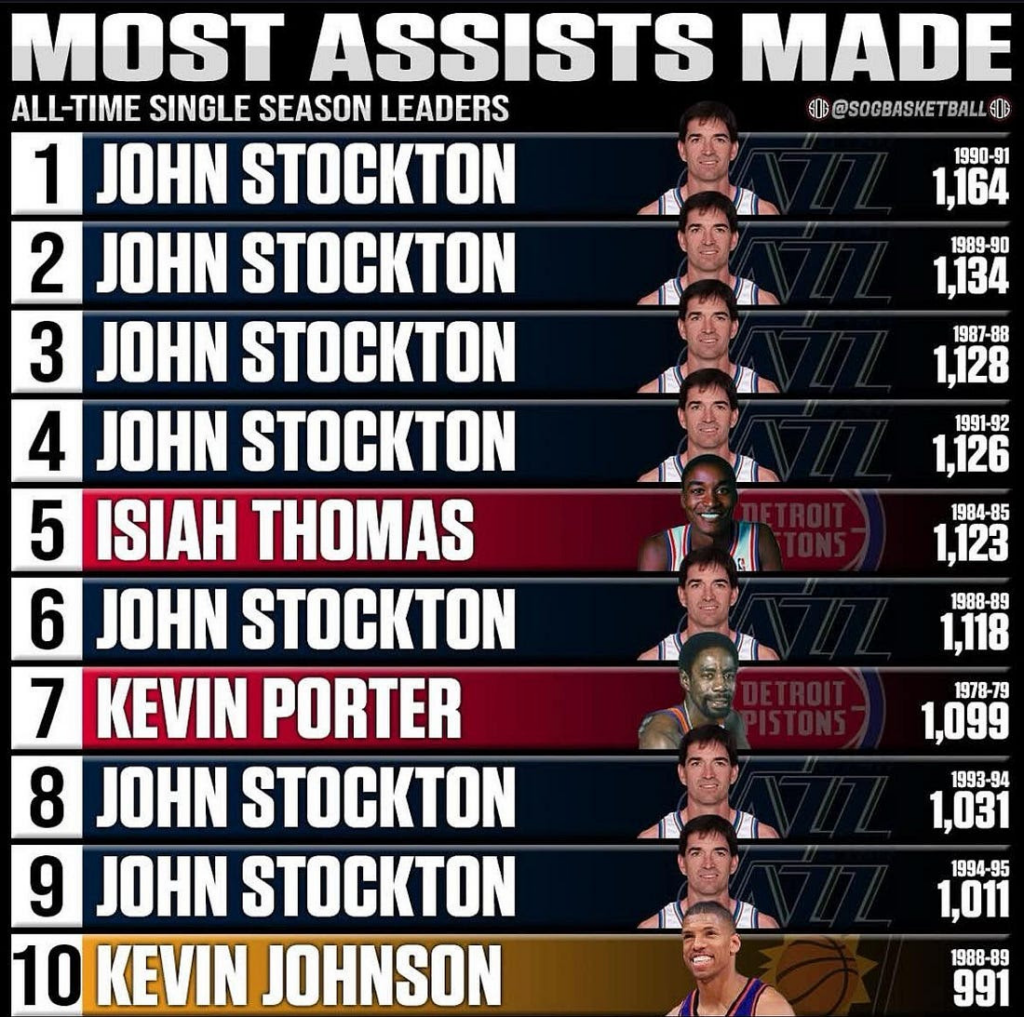
One final postscript: In the making of this month’s Substack, I consulted my resident sports expert—a.k.a. my husband—who loved the concept but worried not all my readers would know who John Stockton is. My response: EVERY SCHOOL LEADER SHOULD KNOW WHO JOHN STOCKTON IS. Consider this your required background reading.