This post originally appeared on Quill and the Classroom.
A couple of weeks ago, my colleagues at Knowledge Matters asked me what I’ve been thinking about lately. My answer was predictable: “Mostly baseball.”
We talk a lot about the “baseball study” around here—that influential experiment in which researchers asked a bunch of middle-schoolers to read a text about baseball and then describe what they had read. The kids who understood the passage best weren’t the best readers. It was the kids who knew the most about the game.
But that’s not what I meant—I was talking about actual baseball. This is the fifth consecutive year that our family has spent “summering” in lawn chairs parked down a first-base line or on a hill overlooking center field. My son plays travel baseball and Little League. My daughter does the same with softball. My husband coaches. By this point in the summer, I’ve watched something like 100 games. If there isn’t a folding chair, a bag of sunflower seeds, and someone yelling, “Two! Two! Two!” from a dugout somewhere nearby, I start to feel disoriented.
Somewhere along the way, baseball has taken on twin meanings: parental cheering and a meditation on cognitive science, in the form of my own thoroughly unscientific “baseball study.” Fortunately, cognitive scientists have conducted considerably more rigorous research than one middle-aged literacy coach sitting behind a chain-link fence with the Gamechanger app and a thermos of coffee. But both have provided fresh insights.
My Five Summer Study: What Changed?
One of the joys of watching your own child play a sport year after year is that you begin to notice things that don’t show up in the box score. My son plays second base, and over the last year or so, I’m noticing something I didn’t see when he was younger. He’s reading the ball differently.
Baseball players actually use that phrase—reading the ball. They mean recognizing, almost instinctively, how a ball is likely to travel the moment it comes off the bat: where it will bounce, how quickly it will get there, and where they need to be before it arrives. Five summers in, by the time the ball takes its first hop, my son often seems to have already figured out where it’s going and where he needs to be. He knows when to charge, stay back, or shade a step to his left. When to take that little first move before the play fully develops.
What’s interesting is that the mechanics of playing second base haven’t really changed very much. He’s still catching fly balls, fielding ground balls, and making relatively routine throws to first. Those are all things he could do a few years ago. The game hasn’t changed. His knowledge has. He’s acquiring expertise.
Of course, he’s grown physically, too—he probably throws a little harder than he did two years ago, and he may be a step faster. But what has changed most isn’t his arm strength or his speed. It’s what he can see on the field. He isn’t simply reacting more quickly to the ball. He’s recognizing patterns in the game that his formerly novice self didn’t see.
And the more I sit in that folding chair watching, the more I realize I’m not really thinking about baseball anymore. I’m thinking about knowledge, literacy, and learning.
What We Know Changes What We Notice
For years, researchers have rightly reminded us that reading is a knowledge-demanding activity. Students understand texts more deeply when they possess relevant knowledge about the topics those texts explore. I think our field has made tremendous progress in recognizing and discussing this over the past decade, and that’s a very good thing.
But sometimes I wonder if folks in the reading field are unintentionally selling knowledge a bit short. I hear “background knowledge” discussed as though it’s simply another instructional strategy—as though “activating prior knowledge” belongs in the same category as predicting, questioning, or visualizing. Those strategies have their place. But knowledge is different.
As Margaret McKeown put it during a webinar last year, reading is an activity that is both knowledge-demanding and knowledge-building. I worry we’ve become much better at understanding the first part than the second. Reading doesn’t just depend on knowledge: it creates it. In other words, knowledge isn’t something we do before or during reading. Knowledge is one of the most important things reading leaves behind.
That’s an important distinction because it shifts our attention from what knowledge supports to what instruction is meant to produce. As Cindy Nebel has pointed out, literacy researchers understandably spend much of their time immersed in reading research. But when we zoom out and consider the broader science of learning, an even richer picture begins to emerge. Knowledge isn’t simply another instructional support that sits alongside predicting, questioning, or visualizing. Building it is one of the primary goals of instruction itself because it is one of the foundations upon which thinking is built. (Cindy discusses this on a fascinating episode of the History Matters Podcast coming out next week!)
Or, as cognitive scientist Paul Kirschner puts it: Learning is a change in long-term memory.
If that’s true—and I think it is—then every successful lesson should leave students with more than today’s answer. Every successful lesson changes the starting point for the next one. Done well, each lesson leaves behind another strand in the web of knowledge students will carry into future learning. Individually, those strands can feel almost invisible, but collectively, they begin to change what students are capable of seeing. They don’t just change what students know. They change what students notice, what they perceive, what they understand, and ultimately, how they make sense of the next text they encounter.
And that’s what struck me as I sat behind that chain-link fence this summer. Cumulative knowledge is funny that way. It rarely announces itself. It accumulates quietly—lesson after lesson, year after year—until one day, almost without warning, its effects become visible.
The Chess Players (and the Second Basemen)
This is where those cognitive scientists come back into the story. They have spent decades studying how accumulated knowledge changes the way experts perceive the world. They have also explored something that I think teachers intuitively understand but don’t always have a name for: the latent effects of learning—the idea that knowledge often accumulates quietly long before its impact becomes visible.
Beginning with the pioneering work of Adriaan de Groot and later expanded by William Chase and Herbert Simon, researchers found that expert chess players don’t outperform novices because they have better memories or faster brains. In fact, when asked to perform general memory tasks, experts and novices look remarkably similar. But when it comes to an actual game of chess, the experts pull away. Years of accumulated knowledge allow them to instantly recognize meaningful patterns on the board. They aren’t calculating every move from scratch—on the contrary, they’re seeing familiar configurations they’ve encountered thousands of times before.
The board hasn’t changed. The player’s understanding of it has.
Reading works much the same way. Experienced readers don’t simply know more facts than novice readers. Their accumulated knowledge changes what they’re able to perceive in a text—what they notice, the connections they make, the inferences they draw, and the ideas they recognize as significant.
And that gradual accumulation of knowledge isn’t just intuitive—it’s been a longstanding topic of study in cognitive science. Research shows that much of what we come to know develops through countless small encounters with ideas over time. Learning often appears slow because each individual experience contributes only a tiny increment. But taken together, those experiences fundamentally reshape what we know, how we think, and ultimately, how deeply we’re able to understand, analyze, and make meaning from the texts we read.
The Long Game
One of the bittersweet realities of teaching is that we’re rarely around long enough to see cumulative knowledge become visible. A fourth-grade teacher doesn’t usually get to watch a former student understand and engage with a Reconstruction speech in eighth grade thanks to building blocks established in elementary school. A middle school teacher may never see how confidently a former student tackles a complex essay in high school because of the countless five-sentence paragraphs they wrote in seventh grade.
Teaching asks us to believe in outcomes we may never witness. Watching my son this summer reminded me why. I wasn’t watching a boy who had suddenly learned how to field a baseball. I was watching five years of accumulated knowledge become visible. That’s one of the hardest—and most hopeful—things about learning. It rarely announces itself. It accumulates quietly, almost invisibly, lesson after lesson, year after year.
Until one day…the ball comes off the bat. And the child knows exactly where to go.
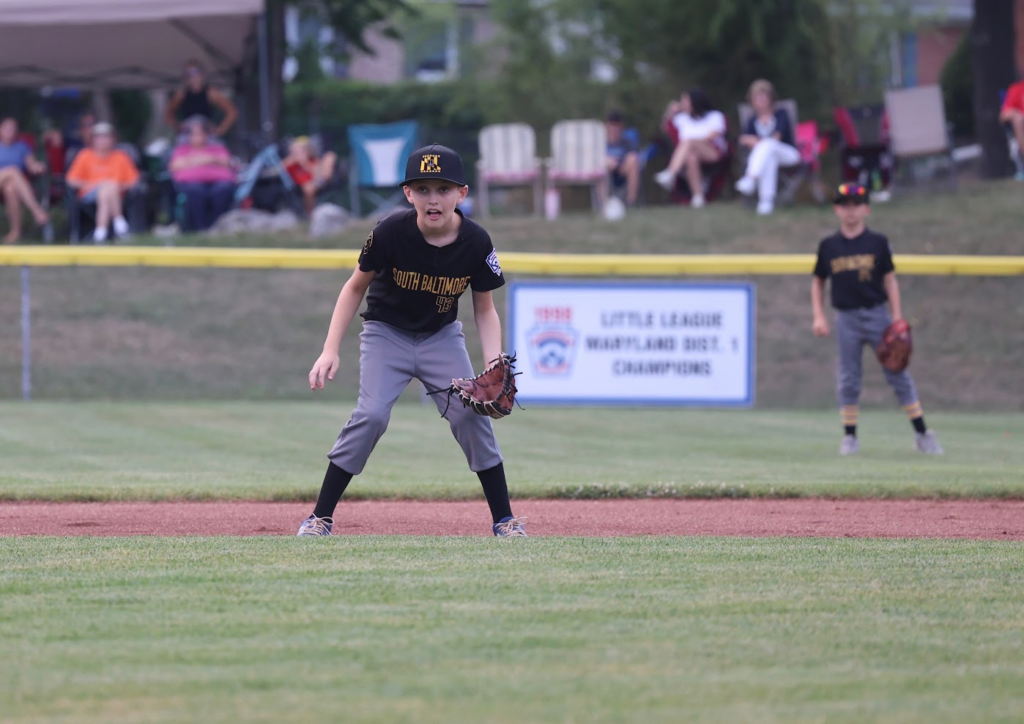
Building baseball expertise at the state Little League championships in Hagerstown, MD.